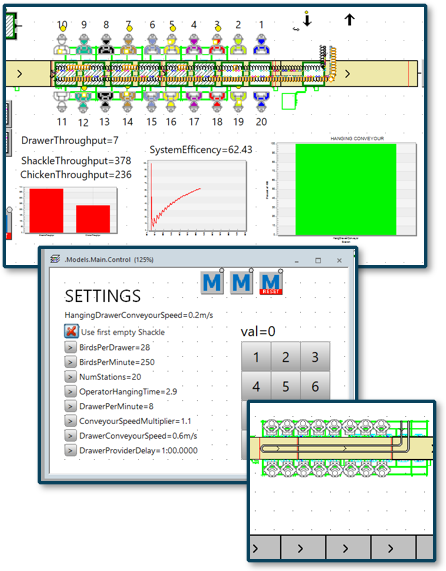
Simulation — Poultry Hanging Area

Development of an operational simulation tool to optimize the combination of conveyor belt speed and number of operators in the Hanging Area.

Simulation — Poultry Hanging Area Optimization
CASE STUDY

Project Overview

In the poultry industry, the Hanging Area is one of the most critical phases of the production process. It is often necessary to determine the optimal combination of conveyor belt speed and number of operators to achieve the best possible performance.

To address this need, I developed a simulation tool that allows setting all production parameters and calculating the impact of each parameter on yield and productivity. The simulator proved to be much more than a simple consulting tool.

THE CHALLENGE

What the client needed

The Hanging Area in the poultry industry is a complex system where performance depends on the interaction of multiple variables. The main challenges included:

  • Determine the optimal number of operators for each shift, considering that too many operators mean excessive costs and too few cause productivity losses.
  • Find the optimal conveyor belt speed that maximizes yield without compromising the quality of the hanging operation.
  • Manage daily variability: different animal batches have different characteristics (weight, size, temperament) that affect operator performance.
  • Provide the client with a tool that could be used daily by operational staff, not just as a one-time analysis by external consultants.
THE SOLUTION

What I built

I developed a complete simulation tool, designed to be used as a daily operational resource by the client:

  • Parametric model: A simulation model that allows setting all relevant production parameters: belt speed, number of operators, batch characteristics, shift duration, and scheduled breaks.
  • Impact calculation: For each parameter combination, the simulator calculates expected yield, productivity per operator, empty hook rate, and other critical operational KPIs.
  • What-if scenarios: Ability to quickly compare different operational scenarios, enabling production managers to make informed decisions before the start of each shift.
  • Operational interface: The simulator was designed with a simple and intuitive interface, usable directly by operational staff without specialized technical skills.
  • Continuous optimization: The tool allows continuously refining parameters based on actual results, progressively improving prediction accuracy.
RESULTS

Project impact

24/7
Daily operational tool
N
Unlimited what-if scenarios
+
Optimized productivity
$
Operational cost reduction

The simulator proved to be much more than a simple consulting tool: it was delivered to the client as a daily operational resource for calculating the efficiency of various production scenarios. It became an integral part of the company's decision-making process, enabling continuous optimization of production line performance. Every day, before shifts begin, operational staff use the simulator to determine the optimal configuration based on the specific conditions of the day.

TECHNOLOGIES

Technology stack

✓
Discrete Event Simulation (DES)
✓
Parametric Modeling
✓
What-If Scenarios
✓
Productivity Optimization
✓
Real-Time Operational KPIs
✓
Operational User Interface

Have a similar project?

I can help you build operational simulation tools that become an integral part of your daily decision-making process.