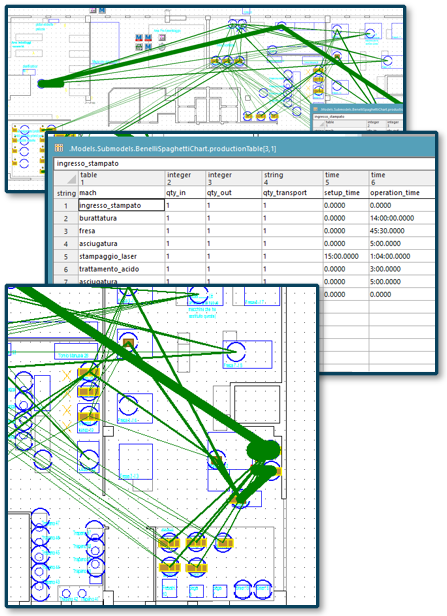
Simulation — Job Shop Paths

Analysis of semi-finished product transport path optimization in a Job Shop production layout using discrete event simulation.

Simulation — Job Shop Path Optimization
CASE STUDY

Project Overview

An Italian manufacturing company operating with a Job Shop production model requested an analysis of their plant layout to optimize semi-finished product transport paths between workstations.

The goal was to determine whether a factory layout reorganization could lead to significant travel time savings, justifying the investment in terms of time and reorganization costs.

THE CHALLENGE

What the client needed

The company suspected that their current plant layout was not optimal and that semi-finished product transport paths between workstations were causing significant time losses. The key questions were:

  • How much time is actually lost transporting semi-finished products between workstations with the current layout?
  • Would an optimized layout bring sufficient time savings to justify the costs and disruptions of physically reorganizing the plant?
  • Which workstations should be repositioned to achieve maximum benefit?
  • How long would the reorganization period last and what would be the productivity losses during the transition?
THE SOLUTION

What I built

I conducted an in-depth process analysis and built a discrete event simulation model to objectively evaluate the optimization potential:

  • Complete flow mapping: Detailed analysis of all semi-finished product transport paths, with measurement of actual travel times and transit frequencies between stations.
  • DES simulation model: Construction of a model that faithfully replicates the behavior of the Job Shop production system, including order variability, processing sequences, and setup times.
  • Theoretical optimized layout: Calculation of the optimal theoretical layout that minimizes total travel distances, taking into account the physical constraints of the plant.
  • Scenario comparison: Comparative simulation between the current and optimized layouts, with statistical analysis of results over representative production periods.
RESULTS

Project impact

<2%
Maximum improvement
NO
Reorganization not recommended
$$
Investment avoided
0
Months of downtime avoided

The simulation revealed that in the best possible scenario, the client would have achieved a travel time reduction of less than 2%. In light of these results, it was recommended not to proceed with the layout reorganization, as it would have caused months of delays and inefficiencies without delivering significant benefits. This case demonstrates how simulation is essential not only for validating interventions, but also for avoiding unproductive investments.

TECHNOLOGIES

Technology stack

✓
Discrete Event Simulation (DES)
✓
Industrial Layout Analysis
✓
Job Shop Modeling
✓
Path Optimization
✓
Comparative Statistical Analysis
✓
Cost-Benefit Analysis

Have a similar project?

I can help you objectively evaluate the optimization potential of your production layout before investing.